
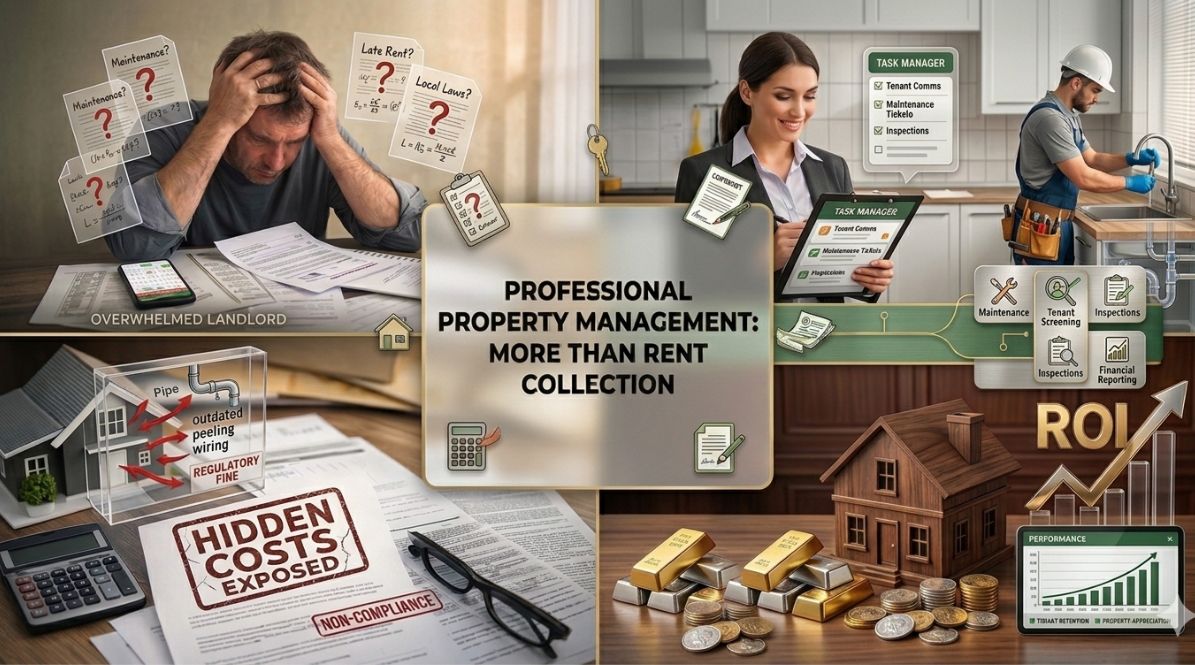
Collect rent, fix what breaks; how hard can it be?
Many DIY landlords think managing a rental is as simple as collecting rent and fixing things. But over time, they start to realize that what looks simple on the surface is tied to a much broader set of responsibilities.
In reality, that mindset overlooks many hidden tasks and risks. Property managers actually juggle legal compliance, tenant screening, maintenance coordination, lease enforcement, financial reporting, market pricing, and more. These functions protect owners’ income, property value, and legal standing.
In Orlando’s market, where recent data show approx 6.2% vacancy and razor-thin profit margins, treating management as easy can leave money on the table and expose owners to lawsuits.
The Myth of “Simple” Landlording
For many landlords, managing a rental property seems fairly simple and is a get-rich-quick scheme.
- Collect rent on time.
- Respond when something breaks.
- Renew the lease when the term ends.
At first, it feels like an easy, repeatable process. But over time, many owners start to realize that what looks simple on the surface is tied to a much broader set of responsibilities.
While often marketed as a way to sit back and rake in the cash, the reality of property management includes handling repairs, marketing, vetting tenants, and mitigating legal liabilities.
What Professional Property Management Actually Covers
Professional property management covers the entire lifecycle of a rental investment through a structured, interconnected system that goes far beyond simply self-managing.
Tenant Screening Isn’t Just a Background Check
Tenant screening is often reduced to a quick credit check or a basic application review. In practice, it’s a structured process based on legally required Fair Housing practices and transparent applicant qualification criteria.
It involves verifying income, reviewing credit history, checking past rental behavior, and looking into eviction records. More importantly, it must be done within legal boundaries.
Screening decisions are tied to federal regulations like the Fair Housing Act and the Fair Credit Reporting Act, which govern how information is collected, used, and communicated to applicants.
Legal Compliance: The Part Most DIY Landlords Miss
Every lease, notice, and deposit handling process sits within a legal framework.
In Florida, even basic elements like lease terms, security deposit handling, and eviction procedures are governed by specific rules.
This is where many self-managing landlords run into issues. Using outdated lease agreements, mishandling deposits, or serving incorrect notices can delay evictions or create disputes that cost both time and money.
Maintenance Is a System, Not a Reaction
Maintenance is often treated as a simple response: something breaks, it gets fixed.
But at scale, it works very differently.
Professional management involves coordinated vendor networks, scheduled inspections, and preventative maintenance plans designed to catch issues early. Instead of reacting to problems, the goal is to reduce how often they occur in the first place.
Financial Reporting & Visibility
Collecting rent is only one part of the financial picture.
Professional management tracks income, expenses, repairs, and ongoing costs in a structured way, typically through monthly statements and year-end reporting.
Instead of simply knowing what the property earns, owners can see how it performs; where money is being spent, how costs are trending, and what the actual return looks like over time.
Pricing & Market Positioning
Pricing a rental property is rarely about picking a number and adjusting later.
It requires understanding local demand, comparable listings, and how the property is positioned in the market.
Set the price too high, and the property sits vacant. Set it too low, and income is quietly lost each month.
Professional managers typically rely on market data and ongoing adjustments to balance these two risks.
The Hidden Cost of Doing It Yourself
Most landlords don’t struggle because they’re incapable of managing a property.
The issue is exposure.
A single weak tenant placement can lead to months of missed rent, property damage, and legal work. In many cases, an eviction alone can cost anywhere from $3,000 to $10,000 once you factor in lost income, legal fees, and turnover expenses.
Legal errors carry their own cost. In Florida, even small mistakes in notices or documentation can delay the eviction process, extending vacancy and increasing losses.
The Hidden Costs of DIY Property Management
Cost Category | Hidden DIY Expenses | Impact & Estimated Cost |
Time & Opportunity | Marketing, 24/7 tenant calls, maintenance coordination, and bookkeeping. | $5,000 to $10,000 yearly (at $50 to $100 per hr) in lost personal/professional time. |
Vacancy & Leasing | Slower re-letting, subpar photos, and a lack of professional syndication tools. | Thousands in lost rent; every week, empty costs 2% of annual income. |
Legal & Compliance | Fines for missed safety checks (e.g., Gas or Electrical) or fair housing/eviction errors. | $3,000 to $7,200+ per violation; a single lawsuit can cost years of profit. |
Maintenance | Paying retail rates for contractors vs. volume discounts; emergency call-out premiums. | 20% to 30% higher repair costs than managed portfolios. |
Tenant Quality | Inadequate background/credit screening leads to bad tenants. | $5,000 to $10,000+ for eviction costs, unpaid rent, and property damage. |
Administrative | Missed tax deductions and accounting errors. | Increased taxable income or potential audit risks. |
Why the Right Property Manager Changes Your ROI
One of the most common assumptions landlords make is that property management is a cost.
In reality, it functions more like a performance layer.
The difference shows up in how the property earns and how consistently it performs over time.
Accurate pricing alone can shift returns. In many markets, professionally managed properties achieve stronger rent positioning and fewer pricing gaps, which directly increases annual income. At the same time, vacancy periods tend to shrink. Industry data shows professionally managed rentals can cut vacancy rates nearly in half, which has a measurable impact on long-term income stability.
Key ROI Driver | How the Right Manager Changes Outcomes | Financial Impact (Estimated) |
Vacancy Reduction | Professional marketing and faster make-ready times fill rentals 2 to 3 weeks sooner. | +$1,200 to $2,500 per rental/year in captured rent. |
Tenant Retention | Prompt maintenance and clear communication lead to higher renewal rates. | Saves $2,000 to $5,000 in turnover costs (paint, cleaning, marketing). |
Optimal Pricing | Data-driven market analysis ensures you aren't undercharging for the area. | +$100 to $300 per month in additional rental income. |
Maintenance Savings | Access to volume-discounted vendor rates and preventative inspections. | 20% to 30% reduction in annual repair and maintenance bills. |
Legal/Eviction Avoidance | Strict screening and compliance with fair housing laws prevent costly disputes. | Saves $3,500 to $10,000+ by avoiding legal fees and lost rent from evictions. |
Final Thoughts
Property management isn't a cost; it’s a performance strategy. While any landlord can collect a check, a professional manager optimizes the variables that quietly erode your profits.
By shrinking vacancies, securing high-quality tenants, and controlling maintenance costs, they transform a passive asset into a high-yield investment. The choice isn't just about outsourcing tasks; it’s about capturing the full financial potential of every door you own.
Frequently Asked Questions
Q1- Which property management companies specialize in marketing rental properties effectively?
Look for firms that actively manage listing performance, not just post ads. Strong companies use professional photos, multi-platform listings, and market-based pricing. In Orlando, Wilson Management Group focuses heavily on positioning properties to attract qualified tenants quickly and reduce vacancy.
Q2- How can I find top-rated property management firms that handle maintenance and tenant relations?
Start with Google reviews, then look deeper. Check how they handle maintenance response times, tenant communication, and lease enforcement. Ask about vendor networks and inspection processes. Top firms don’t just respond to issues; they manage tenant relationships and property conditions proactively through structured systems.
Q3- What are the core responsibilities of a professional property manager?
A property manager handles tenant placement, rent collection, maintenance coordination, legal compliance, and financial reporting. They also manage pricing, inspections, and lease enforcement. It’s not one task, it’s an ongoing system that keeps the property occupied, compliant, and financially stable.
Q4- How do professional property managers handle tenant screening and lease agreements?
Screening includes credit checks, income verification, rental history, and eviction records, done within legal guidelines. Lease agreements are drafted to reflect current laws and clearly define terms, deposits, and responsibilities.
Q5- How to find qualified vendors for rental property maintenance?
Most landlords rely on referrals or trial and error, which is risky. Professional managers maintain pre-vetted vendor networks; licensed, insured, and performance-tested. Companies like Wilson Management Group use established vendors to control costs, ensure quality work, and handle issues faster without repeated guesswork.