
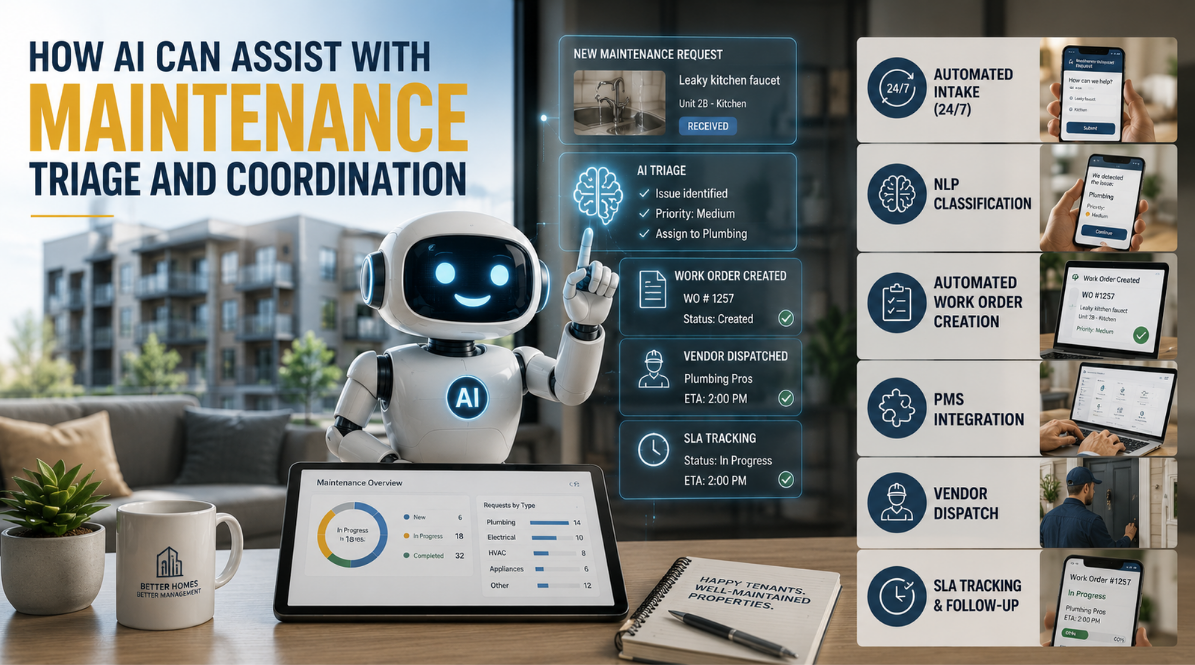
Landlords face rising maintenance burdens: repair costs climbed 13.8% in 2024 in one industry sample, and tenants now expect 24/7 service.
The traditional property management model is hitting a hard operational limit. Individual managers max out at 150 doors due to the administrative weight of manual maintenance coordination.
AI tools fix this problem and promise to help by answering after-hours calls, prioritizing issues, and even spotting failures before they occur.
How AI Triage Works
AI triage transforms messy tenant messages into organized repair orders. It uses a three-step automated process.
Automated Intake (24/7)
AI systems capture maintenance requests via chat, text, phone or app at any hour. Voicemails and unreturned calls vanish. Instead, an AI agent greets the caller or analyzes the message instantly. Tenants hear acknowledgement in seconds; much better than a two-day wait.
NLP Classification
Using natural-language processing, the AI parses descriptions and keywords. For example, it recognizes gas smell, flooding, or no heat as high-priority emergencies. It assigns each request an urgency score like Emergency, Urgent or Routine and tags details like location and equipment from free-form text.
Automated Work Order Creation
Once classified, the AI creates a structured work order in the Property Management System (PMS) with all gathered details. This eliminates manual data entry and ensures nothing is lost. A vague message like kitchen sink leak becomes a complete ticket with unit number, leak description, photos, and contact info.
Example: In practice, companies report response times dropping from approx 4.6 days to under 18 hours when AI triage is deployed.
One study found AI voice agents handled 99% of after-hours calls instantly, where previously 30% to 40% of calls went unanswered.
Maintenance Stage | Legacy Manual Workflow | AI-Assisted Workflow | Investor Impact | |
Tenant Intake | Manual review of scattered SMS, emails, and voicemails. | 24/7 centralized intake across all channels simultaneously. | No missed emergencies; faster response times. | |
Issue Triage | Humans must read every ticket to judge severity and urgency. | Natural Language Processing (NLP) categorizes into 3 safety tiers instantly. | Prevents small leaks from turning into costly structural damage. | |
Data Gathering | Time-wasting phone tags to get photos or appliance models. | Automated chatbot instantly asks tenants for missing photos and details. | Vendors arrive with the correct tools on the first trip. | |
Duplicate Filtering | Multiple tenants report the same issue, causing double dispatches. | Collapses simultaneous requests into one parent ticket. | Saves an average of $4,800 per multifamily incident. | |
Financial Control | High risk of overspending on unvetted emergency dispatches. | Human-in-the-Loop guardrail requires approval for costs over a set limit. | Retains total budget control while removing administrative labor. |
Integrating AI into the Maintenance Workflow
PMS Integration
For AI to be effective, it must connect to your property software. Modern tools integrate via APIs with systems like AppFolio, RentvineYardi, or Buildium.
This means requests, work orders, and updates flow seamlessly: AI pulls resident info and pushes structured tickets into the PMS without any duplicate entry.
Vendor Dispatch
Once a work order is created, AI applies business rules. It checks vendor credentials like insurance, or licensing automatically which act as a compliance gate before any assignment.
Then it selects a qualified vendor from a preferred list based on trade, location, availability, price, and past performance. The chosen technician receives the work order, along with any service level agreement (SLA) requirements, response times, and job details, instantly through a mobile app or text message.
SLA Tracking & Follow-Up
AI platforms can log performance metrics automatically. They track when a tech arrives, whether first-visit fix was achieved, and if promised response windows were met.
After the job, AI can ping the tenant for a completion confirmation or satisfaction rating. This data feeds a vendor scorecard and helps optimize future dispatch decisions.
Human Oversight & Governance
Emergency & Safety Checks
AI is not a substitute for judgment on hazards. Systems will flag things like gas leaks or active flooding, but human supervisors should be immediately alerted for those critical events. Never let AI decide a fire hazard is routine.
Complex Disputes/Diagnoses
Use human techs for ambiguous problems. AI might misinterpret colloquial tenant descriptions. If a request doesn’t fit known patterns, it should be flagged for manual review. Human insight is needed when troubleshooting unusual issues.
Legal and Compliance Limits
Any action with legal implications like eviction orders, lease enforcement, ADA accommodations, etc. must involve a qualified person. Likewise, ensure the AI’s data use complies with tenant privacy.
Monitoring AI Performance
Conducting regular audits is necessary to monitor AI performance and ensure accurate results. Review how maintenance requests are prioritized and vendor assignments are made, and correct any mistakes so the system continues to improve over time. Most importantly, keep people involved in major decisions where experience and judgment matter most.
Final Thoughts
AI can make maintenance more organized, but it doesn't fix properties or replace good judgment.
If used correctly, it helps landlords respond faster, coordinate repairs more efficiently, and catch problems before they become expensive.
The strongest maintenance strategy still combines technology with experienced oversight and reliable local vendors.
Frequently Asked Questions
Can AI maintenance triage actually lower my overall repair expenses?
Yes, by significantly reducing operational friction and administrative waste. It eliminates the cost of manual double-dispatches by automatically collapsing duplicate tenant requests into a single ticket. Faster triage also prevents minor problems from escalating into massive structural restorations.
How do AI systems prioritize urgent maintenance requests?
AI analyzes the tenant's description, photos, and keywords to classify the issue by severity. Emergencies such as water leaks, electrical hazards, or HVAC failures are flagged for immediate attention, while routine repairs are queued based on urgency and property rules.
What features should I look for in AI software for maintenance coordination?
Look for AI that categorizes maintenance requests, supports photo uploads, prioritizes emergencies, tracks work orders, coordinates preferred vendors, and keeps tenants updated automatically. The best platforms improve response times while allowing landlords or property managers to approve key decisions.
Will AI send random vendors to my properties without my approval?
No. Landlords maintain complete financial control through a framework called “Human-in-the-Loop”. You set the legal and operational guardrails. For example, you can program the system to automatically handle scheduling for minor tasks under $500$150, while requiring a physical, one-click dashboard approval before a vendor is ever dispatched for larger repairs.
How does the AI actually gather accurate details from confusing tenant requests?
Instead of a human wasting hours playing phone tag to clarify vague descriptions, the AI acts instantly through automated elicitation loops. If a tenant texts the sink is broken, the AI automatically replies to ask for the exact room location, clear photos of the damage, and appliance model numbers. It bundles this data before passing it to your team.