
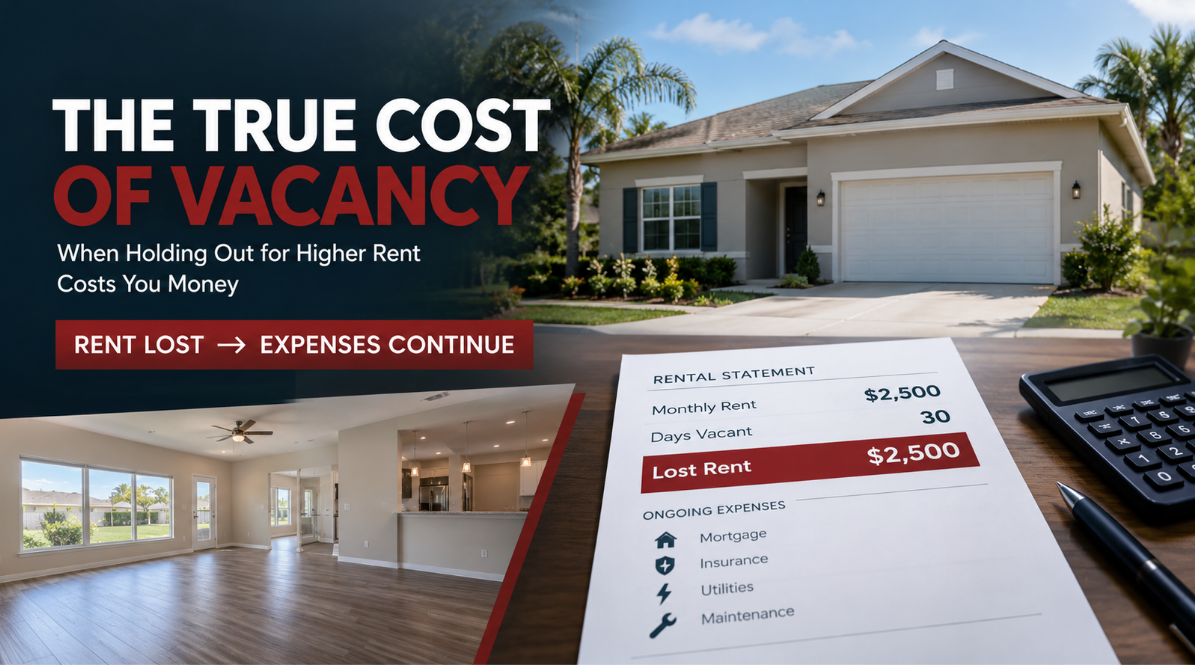
Leaving a rental property empty is an immediate drain on an investor's bottom line. In Orlando's 2026 housing market, a massive influx of new supply has pushed the citywide vacancy rate to 8.9%, giving local renters unprecedented negotiating leverage.
Holding out for top-of-market pricing might seem like a smart way to maximize returns. However, stubborn pricing goals frequently trap landlords into expensive, extended vacancy cycles. Success requires calculating the true, compounding financial damage of an unrented property before an empty listing permanently erodes your annual cash flow.
The Cold Math of an Empty Unit
Many landlords fall into the psychological trap of leaving a property vacant to hold out for a higher price. If your property is worth $1,943, the verified 2026 citywide average rent according to the True North Managed Orlando Market Report, but you insist on holding out for a speculative $2,050, you are actively losing ground.
At that target rent, every single day your property sits empty drains exactly $68.33 in unrecoverable income. If the home stays vacant for just 30 days while you search for an extra $107 a month, you absorb a swift $2,050 cash flow loss.
To recover that single month of vacancy, you would need to collect your extra $107 premium for 19.1 consecutive months just to break even. In a shifting market, listing velocity beats a stubborn price tag every single time.
The True Cost of Waiting: Pricing vs. Vacancy Loss
Asking Rent Strategy | Days to Lease | Immediate Vacancy Cost | Actual Gross Income (Year 1) | Net Financial Impact vs. Market |
$1,959 (Market Rate Index) | 0 Days (Immediate) | $0.00 | $23,508.00 | Baseline Maximum Return |
$2,050 (Above Market) | 14 Days | $956.62 | $23,643.38 | +$135.38 |
$2,050 (Above Market) | 30 Days | $2,050.00 | $22,550.00 | -$958.00 Loss |
$2,050 (Above Market) | 45 Days | $3,074.85 | $21,475.15 | -$2,032.85 Loss |
Note: Annual gross yields are based on a standard 12-month timeline. Daily vacancy loss is calculated by dividing your target rent by 30 days, then multiplying by the days the home sits empty.
When Waiting Causes Renters to Lose Interest
Leaving a property on the market for too long turns it into a stale listing. In Orlando’s 2026 rental environment, standard single-family homes and townhomes generally lease within 28 days when priced accurately.
When a property sits vacant past this window, prospective tenants notice. They begin to assume that something is physically or structurally wrong with the home.
The Invisible Risk of Staying Empty
Every vacant day has a cost. The owner is still carrying the mortgage, property taxes, insurance, utilities, landscaping, and routine property expenses while the home produces no rental income. A higher asking rent only helps if a tenant actually pays it.
Orlando’s 2026 rental market gives landlords another reason to watch vacancy closely. Realtor.com reported 3,311 rental properties in Orlando in September 2026, with median rent at $1,999, down 4.81% from a year earlier. Single-family rental data also shows that 3-bedroom rents in the Orlando market were down 1.34% year over year in August 2026.
That means a landlord waiting for yesterday’s rent level may spend more on vacancy than the additional rent is worth.
The Prospective Tenant Lens
Renters are looking at the homes available today. If several comparable single-family homes offer similar space at lower rents, have better finishes, or are ready for immediate move-in, an overpriced property can lose attention quickly.
The right comparison is not the rent you want to receive. It is what similar homes are asking and how those homes are performing. Current Orlando data varies considerably by property type and location, which makes property-level comparisons more useful than relying on one citywide average.
The Reversal of Leverage
The longer a home sits, the more important the next decision becomes. An owner may eventually have to reduce the rent, offer a concession, or spend money improving the property after weeks of lost income.
The goal is to identify that problem early. Watching inquiries, showings, applications, comparable listings, and days on market gives landlords a clearer picture of whether the property is priced correctly or needs a change.
Strategies to Minimize Vacancy Loss
Reducing vacancy starts with making decisions based on current rental activity, property condition, and the cost of each additional vacant day. Landlords need to watch how their property is performing against competing homes.
Price to the Current Market
Start with comparable single-family rentals, or consider Wilson Management Group's free rental analysis to set realistic rent. Look at homes with similar location, size, condition, bedrooms, amenities, and availability. Current Orlando data shows that single-family rents can move differently by bedroom count, so a citywide figure may not tell you what your particular home should command.
If comparable homes are leasing at lower prices and your property is receiving little activity, the numbers may support a rent adjustment.
Improve the Property Where It Matters
Before reducing rent, look at what renters are seeing. Fresh paint, clean flooring, working fixtures, updated hardware, landscaping, and a clean, well-maintained interior can make a home easier to market.
The improvements should match the property and competing rentals. There is little value in spending thousands on upgrades renters in that market are not willing to pay for.
Consider the Cost of a Concession
A concession can sometimes protect the asking rent while making the property more attractive. For example, concessions like 1-year lease gets a discounted rate can speed leasing and reduce net vacancy loss. WMG can advise on promotions based on local demand data and handle negotiations to protect your income.
Reduce the Gap Between Move-Out and Move-In
Turnover work should start as early as possible. Schedule cleaning, repairs, landscaping, inspections, photography, and marketing so the home can move through the leasing process without unnecessary downtime.
When the property is ready, showings and marketing should not have to wait for every small task to be completed. WMG’s leasing team coordinates make-ready work and marketing concurrently, so showings start before the property is even vacant.
Track Vacancy as a Real Expense
Vacancy should be included in the property's financial planning, but landlords should also track what is actually happening with each turnover. Record days vacant, asking rent, inquiries, showings, applications, concessions, and the final leased rent.
That information makes future pricing decisions easier and helps identify whether the problem is price, property condition, marketing, or leasing activity rather than automatically assuming the rent needs to come down. Professional tools or WMG’s reports can compare your real vacancy rate vs. the market.
Key Takeaway
A higher asking rent only improves returns when renters are willing to pay it. Compare your property with current single-family rentals, track leasing activity, and weigh the cost of each vacant day before deciding whether to hold, adjust the rent, or improve the property.
Landlords should think in terms of effective annual income, not just headline rent. By pricing and preparing homes realistically with WMG’s market insights or a vacancy-loss calculator, you ensure shorter vacancies and higher net returns.
Frequently Asked Questions
Q1- What is the 80/20 rule for rental property?
The 80/20 rule dictates that 80% of your rental income should cover all mortgage payments, operating expenses, and maintenance reserves, leaving 20% as pure net cash flow profit. Leaving a listing vacant completely breaks this financial model, as your fixed 80% carrying costs persist even when your rental revenue drops to zero.
Q2- What is the most effective way for a landlord to predict and minimize vacancy loss?
The best strategy is to establish a proactive 90-day renewal window. Professional property management teams like WMG engage current tenants three months before lease expiration to gauge intentions or secure a renewal.
If the resident decides to move out, this structural lead time allows you to deploy pre-leasing marketing pipelines, scheduling repairs and professional photos and collecting applications for the moment the home becomes vacant. This helps eliminate dead transition days.
Q3- How many days can a property sit vacant before it becomes a red flag to renters?
A property listing achieves its maximum online exposure during the first 14 days of active marketing. Once a listing crosses the 30-day threshold without serious application volume, it officially becomes a stale listing.
High-quality prospective tenants track local market inventory closely; when they see a home lingering past 30 days, they assume it suffers from hidden property defects, maintenance neglect, or difficult management.
Q4- Is the vacancy cost just lost rent, or does it include other expenses?
No. Many accidental landlords look only at the missing rent check, but the true financial drain is significantly higher. Vacancy loss includes your lost rental income combined with continuing fixed holding costs that never pause for an empty home; such as your mortgage interest, property taxes, HOA dues, landscaping, and running the air conditioning to prevent mold in the Florida humidity.
Real estate data shows the actual financial impact of an empty month is typically 1.5 to 2 times the baseline monthly rent.
Q5- What is a safe metric to determine if my rental property is priced correctly for the local market?
Interest in your property is a useful indicator of whether the rent is competitive. Track requested and scheduled showings, along with application requests. If activity is consistently low, compare your asking rent with similar nearby rentals and recent lease prices to determine whether a price adjustment is needed. Aim to secure a qualified applicant within 10 to 14 days, while considering current market conditions and property-specific factors.