
Artificial intelligence is showing up in more parts of property management every year.
According to AppFolio’s Benchmark Report, AI adoption among property managers grew from 21% in 2024 to 34% in 2025. That kind of growth makes sense in an industry where time is tight, expectations are high, and the work never really slows down.
Still, AI should not be seen as a replacement for experience. The best landlords and property managers use it to knock out repetitive tasks, stay organized, and save their time. But when it comes to the big things like resident choices, legal compliance, or investment performance, property managers are still the one in the driver's seat.
Why AI Is Becoming Part of Property Management
Property management has become more demanding. Rising operating costs, growing administrative workloads, and higher resident expectations are pushing landlords to find more efficient ways to manage everyday tasks.
Even today's renters increasingly expect faster communication and a more convenient rental experience.
In fact, AppFolio found that 80% of renters expect property managers to use technology to simplify the rental process. AI helps meet those expectations by handling repetitive tasks that take up too much of the day, leaving more room for the conversations, judgment calls, and relationship-building that really shape the resident experience.
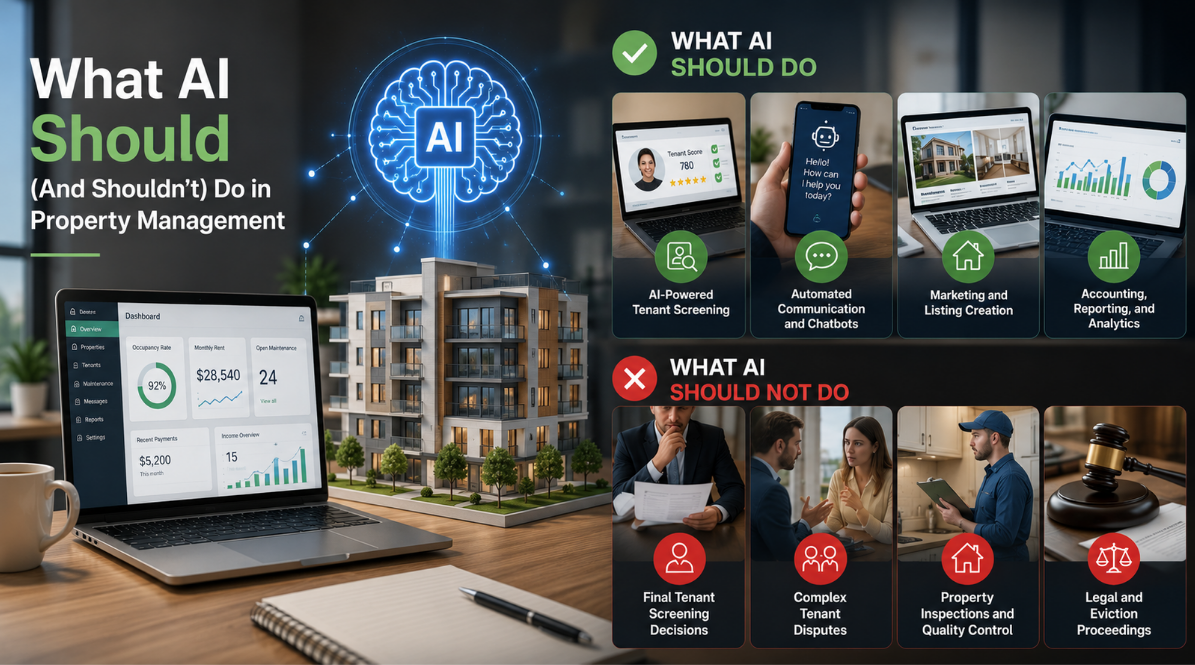
What AI Should Do: Your High-Efficiency Assistant
AI excels at managing monotonous, data-heavy, and time-sensitive tasks. Lean on AI to optimize the following areas of your operations:
AI-Powered Tenant Screening
AI can help bring more speed and structure to the screening process. Instead of manually sorting through every detail, modern tools can review credit, eviction, and background information in minutes, which can help shorten vacancy periods and speed up decision-making.
That being said, AI can look at the whole picture like income and rental history rather than just judging someone by a raw credit.
While these tools offer faster fill times and deeper risk insights for every applicant, they also come with a catch. That is why human oversight is absolutely essential. A professional must always be involved in the final decision to guarantee every step aligns with Fair Housing standards and FCRA rules.
Automated Communication and Chatbots
One of the most practical uses of AI in property management is communication. A chatbot or email assistant can answer common questions, send reminders, and help organize maintenance updates at any hour of the day.
Recent renter research found that a sub-three-hour response to an initial maintenance request is quickly becoming the standard residents expectation. AI tools such as ChatGPT and property management platforms like Stan AI or Ada can answer common questions, and draft appointment reminders, and maintenance updates almost instantly.
This automation easily saves landlords anywhere from 5 to 12+ hours per week on routine communication while keeping prospects and residents thoroughly informed.
However, because AI can occasionally misinterpret requests or provide incomplete answers, it is critical that tenants always have a clear, direct path to reach a real person whenever a situation requires human judgment or immediate attention.
Marketing and Listing Creation
AI can also make the marketing side of property management easier. Using generative AI such as Jasper, ChatGPT, Gemini, a landlord can produce polished ads or social posts in minutes.
Some platforms even auto-posting to over 30 sites to pull in up to three times more leads.
This approach gives you professional-looking ads and consistent marketing without needing a dedicated team, while also making it easy to test different versions of your copy to see what resonates best with renters.
However, because AI-generated copy can sometimes feel generic or overlook local nuances, it is important to infuse your own unique knowledge like specific neighborhood perks and distinct property features into the final output to keep your listings feeling truly authentic.
Accounting, Reporting, and Analytics
AI can also be helpful on the financial side of property management. It can organize bookkeeping, categorize expenses, track income, and make reports easier to review.
For landlords and property managers, that often means getting a clearer view of the numbers without spending hours digging through records. It becomes easier to spot trends, understand where money is going, and stay on top of the bigger picture.
Still, accuracy matters here. AI can only work with the information it is given, which means clean records and human review remain essential. So, it is advised to regularly verify that AI-generated reports perfectly align with your own physical records.
What AI Should Not Do: Where Humans Must Step In
AI can be fast and efficient. It can give a landlord peace of mind knowing that even a 2 a.m. maintenance request, like a burst pipe, can be acknowledged and routed quickly.
But it does not understand nuance the way a property manager does. It cannot read the full emotional context of a situation, weigh fairness in the moment, or respond with the kind of judgment that comes from real experience. So the following responsibilities needs human interactions:
Final Tenant Screening Decisions
AI can help organize applications, verify documents, and flag inconsistencies, but it shouldn't decide who gets approved.
Tenant selection must consider context, Fair Housing requirements, and individual circumstances; judgment that automated systems can't reliably provide.
Complex Tenant Disputes
When a tenant falls behind on rent due to a family emergency or job loss, an automated template feels cold and hostile.
These are the moments when a human response matters most. Whether the issue is a late payment, a neighbor dispute, or a lease agreement, the solution often depends on listening well, reading the situation carefully, and responding with a little more patience than a machine can offer.
Property Inspections and Quality Control
AI can help organize inspection notes or track maintenance history, but it cannot walk into a unit and notice what a trained eye would catch.
It cannot smell mold, feel a soft spot in a subfloor, or notice the subtle scent of unauthorized smoking during a walkthrough.
Evaluating whether a turnover clean or a roof repair was actually completed requires professional attention.
Legal and Eviction Proceedings
AI can draft notices or explain general procedures, but it should never replace legal judgment.
Evictions and lease enforcement must comply with state and local laws, where even small errors in documentation or timing can result in delays, added costs, or legal disputes.
Final Thoughts
AI can make property management more efficient, but it can't replace sound judgment.
The best results come from using technology to handle repetitive tasks while leaving tenant relationships, legal responsibilities, and investment decisions in experienced hands.
Frequently Asked Questions
What tasks in property management are best suited for AI automation?
AI is most effective at repetitive administrative work, including responding to common tenant inquiries, sending rent reminders, organizing maintenance requests, scheduling inspections, and generating reports. These tasks save time without replacing the judgment needed for managing people or protecting an investment.
Where should human oversight remain critical in AI-driven property operations?
Human oversight remains essential for tenant screening decisions, lease enforcement, legal compliance, dispute resolution, property inspections, and rent pricing. These responsibilities require context, local market knowledge, and legal awareness that AI cannot consistently apply in real-world situations
How can AI help reduce maintenance costs in rental properties?
AI helps reduce maintenance costs by organizing work orders, identifying recurring issues, prioritizing urgent repairs, and tracking maintenance history. Better coordination allows small problems to be addressed sooner, helping landlords avoid expensive emergency repairs and unnecessary contractor visits
What are the risks of relying on AI for rent collection processes?
AI can automate reminders and identify late-payment patterns, but it shouldn't handle every collection decision. Automated messages may overlook payment disputes, or exceptional circumstances, creating unnecessary tension and damaging otherwise positive landlord-tenant relationships
Are there AI tools that can predict tenant turnover in residential buildings?
Yes. Some AI platforms analyze factors such as lease renewals, maintenance history, communication patterns, and payment behavior to estimate turnover risk. These predictions can help landlords identify residents who may need additional attention, but they should support, not replace, direct conversations with tenants.